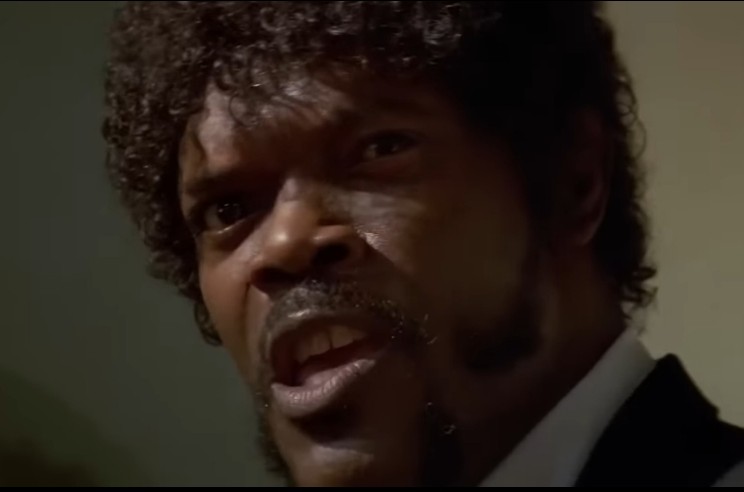
What’s the difference between ‘what’ and ‘which’? If it were Jules, played to perfection by Samuel L. Jackson in Quentin Tarantino’s Pulp Fiction, asking me the question, I’d be trying pretty hard to get the answer right.
The well-known catchphrase comes from the hilarious scene in which Jules is questioning a very scared young man, who, being so scared, can only answer ‘what?’, which* makes his interrogator increasingly angry.
‘What does Marcellus look like?’
‘What?’
‘What country you from?’
‘What?’
‘What ain’t no country I’ve ever heard of! They speak English in What?’
‘What?’**. . . .
Needless to say, being Tarantino, violence and swearing abound in the scene. You have been warned..
So what was the question again?
The difference between these two words is actually pretty simple; is there an unlimited or a limited choice?
What‘s your favourite film? (an unlimited choice)
Which of Quentin Tarantino’s films do you like (or dislike) the most? (a limited choice)
Admittedly, there are times when it may not be clear where limited becomes unlimited, just as sometimes it’s hard to say where general becomes specific if you’re deciding whether to use the definite article ‘the’ or not. But hey, it’s a pretty straightforward rule so one worth hanging on to.
To wrap this up***, here’s Urge Overkill’s version of the Neil Diamond**** song ‘Girl, You’ll Be a Woman Soon’. Which do you prefer, the original or the cover?
*Here, ‘which’ is a relative pronoun in a non-defining (extra information) clause. You couldn’t use ‘what’ or ‘that’ instead.
**’quotation marks’ are also known as «speech marks». In British English we normally use the former (the first one) where American English prefers the latter (the second). If there’s a quote within a quote or similar, then you’d use the ones you didn’t use to begin with; for example, the title of this post.
***As you probably know, we use ‘wrap (up)’ when we put decorative paper around a present. It can also be used with the meaning of finishing something. The adverb ‘up’ can reinforce this idea; you’ll see it in cases like: ‘drink up, the bar’s about to close’, ‘eat up up your vegetables, otherwise you won’t get an ice-cream’ or the classroom classic ‘shut up!’ In the film industry, ‘it’s a wrap’ is an expression used to say that the shooting is over and the film is finished.
****We can use names as if they were adjectives. So you say ‘Reservoir Dogs is a Tarantino film’ (not a Tarantino’s fim!). However, you might also mention ‘Tarantino’s latest movie’ or ‘Neil Diamond’s original version of the song’.
 Academia de Inglés Robin