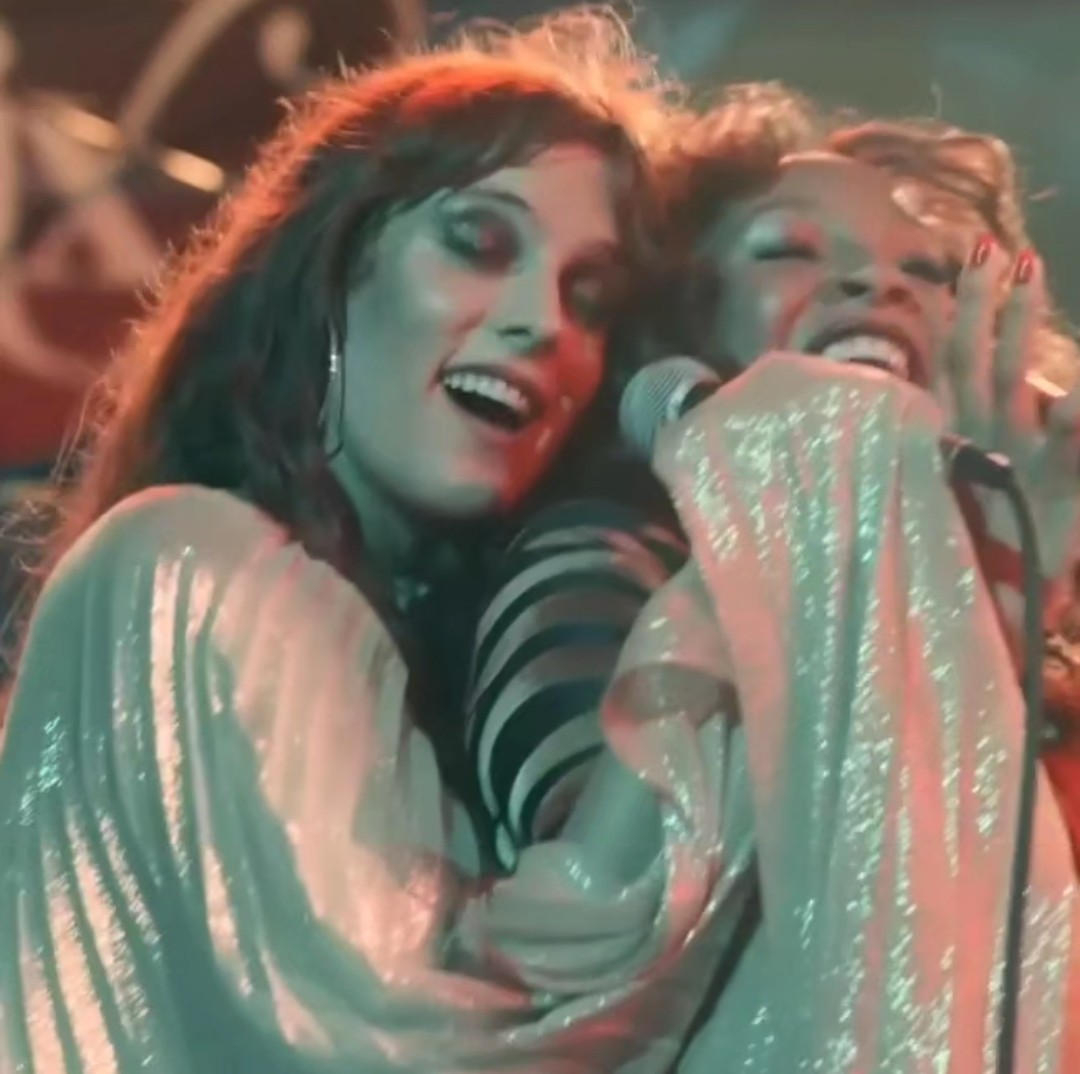
Fiction that’s just a heartbeat away from fact. I loved this TV series.
So the plot of the book Daisy Jones and The Six that then became the series is loosely based on the rocky relationship between Stevie Nicks and Lindsey Buckingham of rock band Fleetwood Mac in the seventies. But there’s a whole lot more to it than just that. And the reason for that ‘whole lot more’ is the fact that we’re talking about the late sixties and early to mid-seventies, a time at which women were finally getting to do things their own way. Oh, and also one of the most intensely creative and exciting times in the history of rock ‘n roll.
The band that Daisy joined was called The Six. There were five of them*. It makes perfect rock ´n roll sense.
The influence of certain bands and singers on other bands and singers, as well as being blatently obvious in many cases, can also be kind of interesting to observe. The latter** is also true of the women who we can see reflected in the character of Daisy; women who made themselves heard on equal terms to the men in the face of a music industry that was still inherently sexist.
So here’s another six: six real singers just a heartbeat away from fictional Daisy in those mind-blowing years of rock ‘n roll.
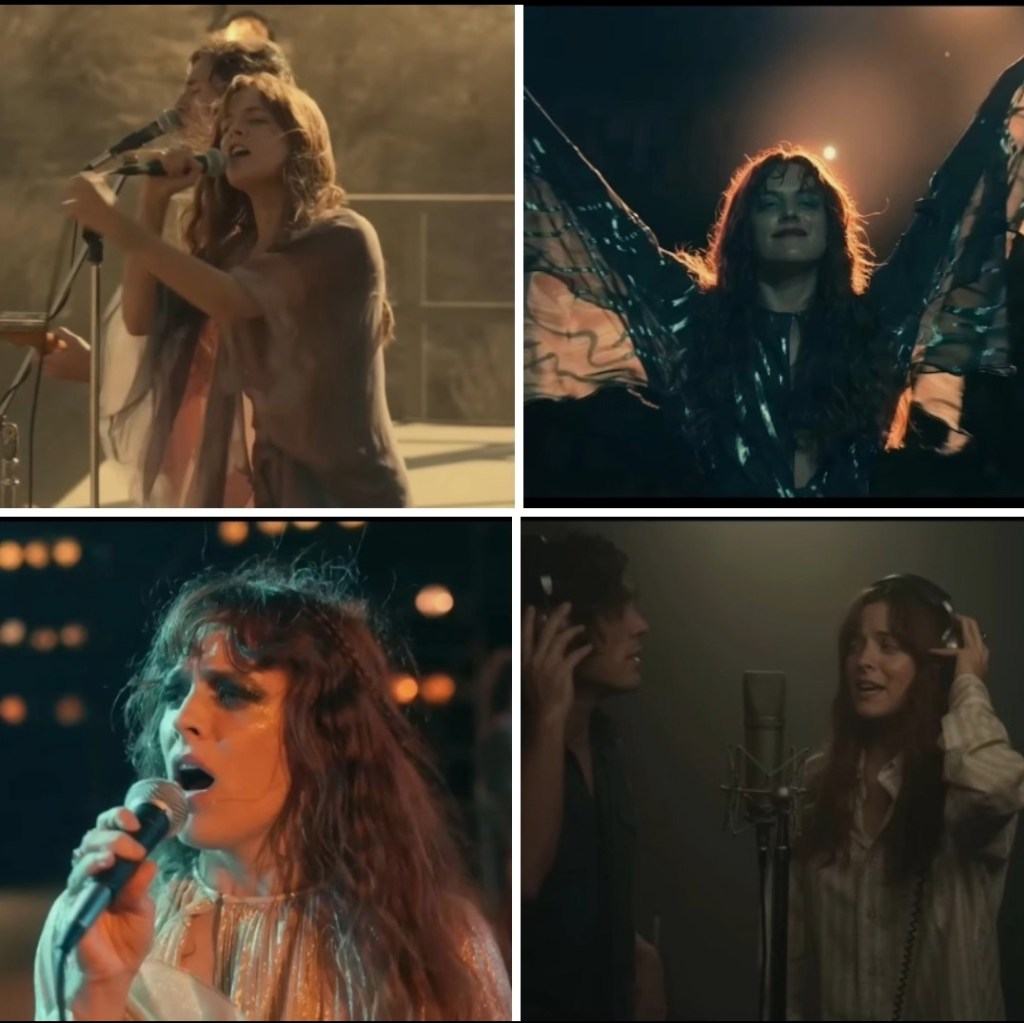
Grace Slick of Jefferson Airplane does look awfully*** similar to Daisy Jones. Or should that be the other way around? And just like Daisy, she brought her own songs to a band that was already up and running. The song ‘White Rabbit’, from their 1967 record Psychedelic Pillow is, without a shadow of a doubt, one of the greatest and most emblematic songs of the era. Partly inspired by the novel Alice in Wonderland, Grace Slick would later say that it was a call for women of the time to push their own agenda and to follow their curiosity, just as Alice did. The song reaches its crescendo with the unforgettable lyric: «Remember what the dormouse said, feed your head«
Carole King is one of the greatest songwriters of all time. And that’s a fact. That’s where you feel her presence so much in the series. There’s a wonderful, kind of magical scene in the first episode where Daisy sneaks into a gig at the legenday Whiskey-a-Go-Go and sees The Byrds playing the Carole King song ‘Goin’ Back’. Another, in which she marvels at Carole’s record Tapestry and talks of this songwriter finally giving her own voice to her songs, is even greater.
Linda Ronstadt might have been the first ‘alternative country’ singer. There aren’t many country singers that would cite Maria Callas as their primary influence. But that’s really beside the point****. More to the point**** is the way Linda sang the songs she chose to sing. And more often than not, that’s how and when she made them her own. Early in the series we heard her sing ‘Different Drum’ when she was in the band The Stone Poneys. Further along the timeline, I can imagine Daisy belting out a version of the Little Feat song ‘Willin’, something like the way Linda does here.
Janis Joplin was one of the first to form part of what’s known as The 27 Club, whose ‘members’, if we can call them that, are musicians who died at that untimely age: Kurt Cobain, Amy Winehouse, Jimi Hendrix, Brian Jones…
Riley Keough, who plays Daisy in the series, spoke of how a letter written by Janis Joplin shortly before she died had been a source of inspiration for her portrayal of the character. Janis appeared to be ‘broken’, what with her alcoholism and heroin addiction, but even so in the letter to her family she wrote of the wonder she still felt when performing. ‘Broken’ is a key word in the series but the transcendental power of music, of music as an escape and a source of hope is as essential to the plot of the series as it is evident in Janis’ version of ‘Me and Bobby McGee’. After all, «freedom’s just another word for nothing left to lose«
Joni Mitchell once said «Ask anyone in America where the craziest people live and they’ll tell you California. Ask anyone in California where the craziest people live and they’ll say Los Angeles. Ask anyone in Los Angeles where the craziest people live and they’ll tell you Hollywood. Ask anyone in Hollywood where the craziest people live and they’ll say Laurel Canyon. And ask anyone in Laurel Canyon where the craziest people live and they’ll say Lookout Mountain. So I bought a house on Lookout Mountain.»
Unsurprisingly, Laurel Canyon, home to many musicians who worked within the counterculture of the sixties and seventies, is where Daisy and The Six go to live as their career begins to take off. Other than that, the Joni – Daisy thing is just that the former ** seems to be present around the events of the narrative, such was her influence and importance in the music of those times. So here’s Joni along with two other women whose music and voices made the scene: Cass Elliot of The Mamas and The Papas (also a denizen of Laurel Canyon) and Mary Travers of Peter, Paul and Mary.
Finally, with Stevie Nicks, we get to the true fiction. As mentioned above, author Taylor Jenkins Reid took Fleetwood Mac as primary inspiration for the best-selling novel that would then become the hit TV series. The band’s record Rumours, which has sold over 40 million copies, was recorded in extremely messy circumstances due to the break-ups of couples within the band and other relationship shenanigans*****, all of which was fuelled by enormous quantities of cocaine and champagne. Quite a party.
Rumours is one of those records that’s amazing on two levels: musically, of course but also because it seems miraculous that it ever got made, given the circumstances. Christine McVie, the other woman in Fleetwood Mac in 1977, can also be recognised in the character of Karen Sirko, keyboard player in The Six. It’s great to know that Stevie Nicks not only approves of her portrayal, if we can call it that, but actually loves it and believes that Christine McVie, who died last year, would have felt the same.
Great singers, songwriters and musicians and a highly watchable series. What’s not to like?
*A common mistake made by Spanish speakers is to say ‘we are five’ when you mean (OK, not you..it’s never you) ‘there are five of us’.
**Remember that you’re bound to impress and score points with your writing if you use ‘the former’ and ‘the latter’ to refer back to the first or the second of two things you previously mentioned.
***As you know ‘awful’ means ‘terrible’. But we can use ‘awfully’ to mean ‘very much so’ even if we’re talking about something positive. So you could say ‘The concert was awfully good’. Isn’t that awfully good news?
****Typical phrases with ‘point’ that you could use: ‘You’ve got a point’ / ‘That’s a good point’ = ‘I agree with you’, ‘That’s beside the point’ = ‘That’s irrelevant’, ‘The point is..’ = ‘The important thing is….’
*****’shenanigans’ is a wonderful word, definitely in my all-time top twenty words in English. You can use it to refer to ‘secret or dishonest activity’ as well as ‘high-spirited or mischievous behaviour’. It’s also the name of a record by Green Day.
If you’ve read this far, then thanks for reading!
 Academia de Inglés Robin